Understanding behavior in exceptional student education

Many parents of children in ESE experience challenges related to emotional regulation, frustration tolerance, and behavior during difficult or unfamiliar tasks. This can include things like meltdowns, refusal, shutting down, impulsive actions, or difficulty with transitions between activities or settings. These behaviors are often not intentional, but are a child’s way of communicating that something is overwhelming or challenging.

Practical strategies and support

Parents often want to understand both why behaviors are happening and what they can do to support their child. This section focuses on simple, practical strategies you can use at home, along with guidance on how behavior is supported at school. By using consistent routines, clear expectations, and positive reinforcement, you can help your child learn more appropriate ways to respond. With the right support and consistency, children can build the skills they need to manage their behavior and be successful.
Behavior as communication

One of the most important things to understand is that behavior is a form of communication. When a child is acting out, shutting down, or refusing, they are often trying to express that something is too hard, overwhelming, or unclear. Instead of focusing only on stopping the behavior, it’s helpful to ask, “What is my child trying to tell me?” When parents understand the reason behind the behavior, they can respond in a way that teaches a more appropriate skill—such as asking for help, taking a break, or using words to express feelings.

Creating consistent routines

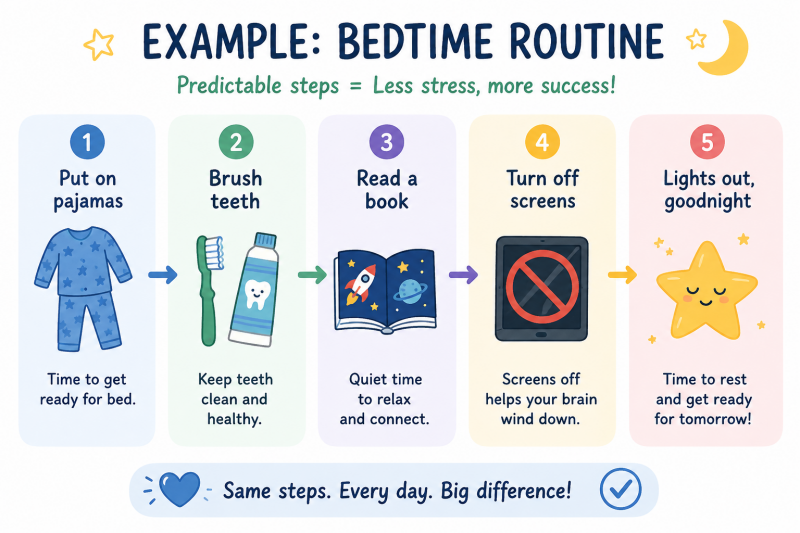
Creating consistent routines helps children know what to expect throughout their day, which can reduce anxiety and improve behavior. When routines are predictable, children feel more secure and are better able to focus, follow directions, and manage transitions. Pairing routines with clear, simple directions and preparing children ahead of time for changes can make daily activities smoother and more successful.

Start with one routine—morning, after school, or bedtime.

Positive reinforcement

Positive reinforcement helps children learn which behaviors are expected by focusing on what they are doing right. When you notice and praise effort, progress, or positive choices, your child is more likely to repeat those behaviors. This can include specific praise (“I like how you stayed calm”), small rewards, or simply acknowledging their effort. The key is to be consistent and immediate so your child clearly connects their behavior to the positive response.

Examples of Positive Reinforcement:

  • “I’m proud of how you handled that.”
  • “You did a great job following directions.”
  • Sticker charts or small rewards
  • Extra free time or choice time

Teaching coping skills

Teaching coping skills helps children learn how to manage big emotions in a safe and positive way. Instead of reacting with frustration, shutdowns, or outbursts, children can learn strategies to calm their bodies and communicate their needs.

Coping skills should be taught during calm moments—not in the middle of a meltdown. Just like any other skill, children need time, practice, and support to learn what works for them.

💬 Sentence Stems for Parents

  • “Let’s practice what you can do when you start to feel upset.”
  • “I see you’re frustrated. What strategy can you use right now?”
  • “Do you need a break or help?”
  • “Let’s take some deep breaths together.”
  • “I’m proud of you for trying to calm your body.”

💡 Quick Tips

  • Teach skills when your child is calm
  • Keep strategies simple and easy to remember
  • Practice often (not just when there’s a problem)
  • Celebrate effort, not perfection
  • Be consistent with expectations and responses

Staying calm and consistent

Staying calm and consistent as a parent can make a big difference in how a child responds over time.

💬 Sentence Stems for Parents

  • “I’m here. We’re going to figure this out together.”
  • “I see you’re upset. Let’s take a moment.”
  • “When you’re calm, we can talk about what happened.”
  • “I’m going to help you through this.”
  • “Let’s use one of your strategies.”

💡 Quick Tips

  • Pause before responding—take a breath first
  • Keep your voice calm and your words simple
  • Follow through with what you say every time
  • Avoid arguing or over-explaining in the moment
  • Address the behavior after your child is calm

External resources

This section connects you to trusted resources that can help you better understand and support your child’s behavior. These materials provide simple explanations of why behaviors occur and offer practical strategies you can use at home. Whether you’re looking for quick tips or a deeper understanding, these resources are here to guide and support you.

BehaviorBandAid.com

Behavior Basics from FSUCard

How schools support behavior

Schools support behavior by teaching, modeling, and reinforcing positive skills—just like they do with academics. When a child is struggling with behavior, the goal is to understand the why behind it and provide supports that help the child respond in more appropriate ways.

Teachers and school teams use a variety of strategies, such as clear expectations, consistent routines, and positive reinforcement to encourage desired behaviors. Many students also receive additional supports like small group instruction for social skills, check-ins with staff, or behavior goals built into their IEP.

In some cases, the team may develop a Behavior Intervention Plan (BIP) based on a Functional Behavior Assessment (FBA). These tools help identify what triggers a behavior, what the child is trying to communicate, and what strategies will best support them.

The goal is not to punish behavior, but to teach replacement skills—helping the child learn what to do instead. Schools also work to create a supportive environment where students feel safe, understood, and successful.

FBA Made Simple

What is an FBA? (Functional Behavior Assessment)

Think of this as the “WHY” behind behavior

➡️ Behavior:
Student puts head down and refuses to work

➡️ When it happens:
During independent reading time

➡️ What happens before (Trigger):
Given a task that feels too hard

➡️ What happens after:
Student avoids completing the work

➡️ Why it’s happening:
To avoid frustration or difficult tasks

BIP Made Simple

What is a BIP? (Behavior Intervention Plan)

This is the “PLAN” to support the behavior

➡️ Goal:
Help the student stay engaged and complete tasks

➡️ Teach (Replacement Behavior):
Ask for help or a break instead of shutting down

➡️ Support Strategies:

  • Break work into smaller chunks
  • Provide guided help
  • Check in frequently

➡️ Reinforcement:

  • Praise effort
  • Reward task completion
  • Celebrate small wins

➡️ Consistency:
Same strategies used across settings (school + home)

You are not alone

The most important message for parents to take away is that behavior is a form of communication, and their child is not “being bad,” but often showing that something is too hard, overwhelming, or unclear. With the right understanding, support, and consistency, behavior can improve over time. We want parents to feel encouraged and confident, knowing that they are not alone and that there are practical strategies that can make a real difference.